
Associative Thinking: The Intelligence We Forgot We Had

There’s a kind of thinking that happens before logic kicks in. Before the frameworks, before the bullet points, before the “right answer.”
It’s the reason you smell coffee and suddenly you’re back in your grandmother’s kitchen at age seven. It’s why a song can make you cry without knowing why. It’s the connection your brain makes between things that don’t seem connected — until they are.
This is associative thinking. And in a world obsessed with linear productivity, it might be the most undervalued form of intelligence we have.
What It Is
Associative thinking is the mind’s natural ability to link ideas, memories, feelings, and images without following a logical sequence. One thought leads to another — not because of cause and effect, but because of resonance.
It’s the opposite of analytical thinking, which moves step by step from premise to conclusion. Associative thinking moves sideways. It jumps. It surprises.
Freud called it free association — the practice of saying whatever comes to mind without filtering. He used it to access what people actually felt versus what they thought they should say. Turns out, the unfiltered stuff is where the truth lives.
How It Differs
We’re trained in analytical thinking: identify the problem, gather data, evaluate options, choose. It’s powerful. It’s also limited.
Analytical thinking works beautifully when the problem is defined. But what happens when you don’t quite know what the problem is? When the challenge is ambiguous, emotional, or new — like navigating AI in your work, or leading a team through uncertainty?
That’s where associative thinking shines. It doesn’t need a defined problem. It works with impressions, hunches, and half-formed ideas. It surfaces patterns that logic alone would miss.
Analytical vs. Associative:
Movement: Linear and sequential vs. Non-linear and lateral.
Strength: Solving defined problems vs. Surfacing undefined ones.
Access: Conscious and deliberate vs. Often unconscious and spontaneous.
Output: Conclusions vs. Connections.
Why It Matters Now
The world we live in is not linear. Markets shift overnight. A technology rewrites the rules of an entire industry before anyone has finished reading the manual. A pandemic rearranges how we work, live, and relate — and then we’re expected to “go back to normal.”
And yet, the dominant approach to most of these challenges is still linear: identify the problem, gather data, build a plan, execute. Step by step. Cause and effect.
That works when the problem sits still. But the problems that matter most — organizational transformation, AI adoption, cultural change, generational tension, meaning at work — don’t sit still. They’re interconnected, emotional, and ambiguous. They resist spreadsheets.
Here’s what I’ve noticed in two years of working with executives: the biggest barriers to navigating complexity aren’t technical. They’re emotional. They’re about identity, fear, and meaning. And you can’t access those through a survey or a strategy deck.
You access them through association — through drawing, storytelling, metaphor, and conversation that allows the unexpected to emerge. When I ask someone to draw their relationship with change, they don’t draw a flowchart. They draw tornados, bridges, walls, open doors, monsters, and gardens. These images carry more strategic insight than most reports I’ve read.
How to Use It
You don’t need a workshop to practice associative thinking. You just need to stop filtering.
Next time you face a complex decision, try this: instead of listing pros and cons, write whatever comes to mind for five minutes without stopping. Don’t edit, don’t judge, don’t organize. Just let it flow.
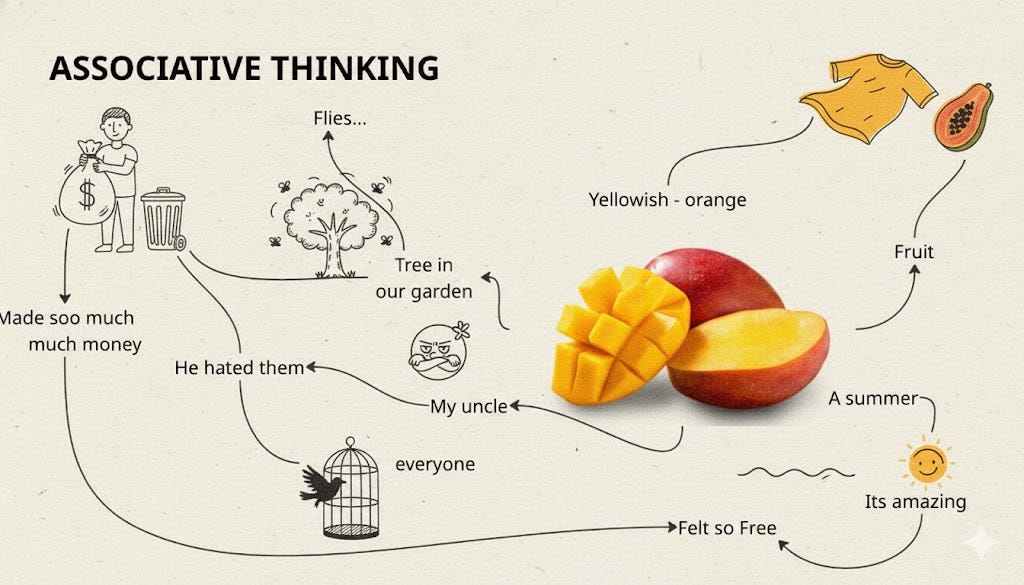
Then read it back. The patterns you find will tell you something your analytical mind was too busy to notice.
The best leaders I’ve worked with aren’t the ones who think fastest. They’re the ones who know when to stop analyzing and start listening — to their teams, to the signals around them, and to the quiet voice inside that connects what the spreadsheet can’t.
That voice is associative thinking. And it’s been there all along.
This is what Creatism is about. The belief that creativity — real creativity, the kind that connects, surprises, and reveals — is not a luxury reserved for artists. It’s a core leadership capability. It’s how we navigate what logic alone can’t solve. Associative thinking is one of its most powerful expressions.
— Diego
I really enjoyed this piece. As a creative director, I’ve spent years navigating team and client buy-in around projects and ideas. I’ve observed that at work, when faced with a choice, most people default to what is measurable, defensible, and appears logical. Whatever we can explain to ourselves and our managers is deemed good. But as your piece illustrates, that logical rationale is incomplete, and often of little use. In trying to be professional, we mistake explainability for wisdom, and lose the latter in the process. Associative and analytical thinking must co-exist, but in separate and equally-weighted lanes. One without the other is a fool's position.
Great piece, Diego. Thanks for sharing.