
The Creatist Origin Story
How I stopped consuming other people’s lives and started building my own.

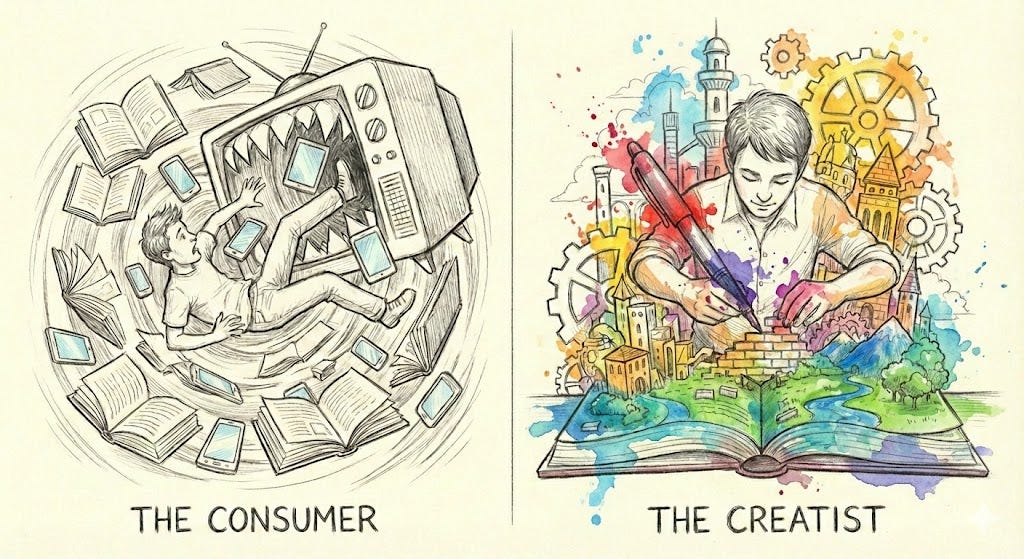
College, 2002. My friend sat hunched over turntables in his dorm room, headphones on, lost in the mix. Hours would pass. He’d surface occasionally, eyes bright, to play me what he’d created.
Meanwhile, I was on the couch. Reading. Always reading.
“What’s your passion?” I’d ask myself, watching him work. “What could you dedicate hours to like that?”
I had no answer. Just books. Other people’s ideas. Other people’s stories. Other people’s music playing while I consumed their words.
The Consumption Years
I didn’t know it then, but I was becoming a professional consumer. I could tell you about every book I’d read, every movie I’d seen. Just don’t ask me to remember the names of the characters, or the specific plot points, or the tracks on the album. I remembered the relationships, the flow, the dynamics—the feeling of them.
But what had I made? Nothing.
I tried keeping a journal once. A small, pocket-sized diary where I’d write about my day—simple celebrations of living. Then my friends found it. They read it aloud. They made it a joke.
I stopped writing. I’m not sure if it was because they made fun of me or simply because I let it go. But I did.
Besides, my handwriting was doctor-scratch—not clear, not sharp. My notes were messy, my drawings chaotic. The pattern was set: Physical output (surfing, rugby, skateboarding) was acceptable. Creative output was not. Vulnerability was not my thing.
Málaga, Summer 2003: The First Crack
I went to Spain that summer. Ended up in Málaga—Teatro Cervantes, blocks from Plaza de Málaga, close enough to the beach. I shared an apartment with a flight attendant who was always on call playing Zelda, and Manolo, a construction equipment salesman with the filthiest jokes you’ve ever heard.
I had six jobs that summer. Bartender. Coffee house. Waiter. Whatever paid. But between shifts, I went to the beach and read ferociously.
John Updike’s Brazil. Katherine Neville’s The Eight. Soldados de Salamina. Even a series of eccentric erotica I found in a used bin. But this time, I wasn’t just reading. I was underlining. I was writing page numbers in the back. I was noting why certain passages hit, why a phrase was powerful.
One night, I remember feeling this wild hunger for information. I read an entire newspaper cover to cover. Not scanning—savoring. The writing itself. The way sentences moved. How ideas built.
I didn’t know I’d become a writer years later. But that summer, I started.
The Ayn Rand Spiral (Or: How I Consumed Myself Into Crisis)
After Málaga, I doubled down on consumption. But now I was consuming ideas. Philosophy. Meaning. Purpose.
The Da Vinci Code was everywhere, but I found Ayn Rand instead. The Virtue of Selfishness. Then The Fountainhead. Then Atlas Shrugged. Before I knew it, I was graduating from college with a full-on existential collapse. It was a dark time, but also an easy time to get lost. I opened Don Quixote for the first time—the classic version—and hid inside it.
As the summer progressed, I didn’t get the job in New York. Nor the one in Boston. Nor the one in Miami. I moved to Costa Rica with a head full of other people’s answers and zero of my own.
This is what consumption does when it’s unbalanced: It fills you with questions you can’t answer because you haven’t made anything to test them against.
The Long Silence (Six Years of Drift)
Costa Rica. After a few months bouncing around, I landed a job that helped my career take off. It paid the bills and polished some skills. I discovered I was good at analyzing data—automating the boring stuff, yes, but mostly finding the story between the numbers and reality.
Halfway through these years, I jumped into photography. I bought myself an impressive kit. I took photographs of friends, family, boxing matches, fish markets. I even started working as a photographer here and there.
But looking back, it was still a form of hiding behind a tool.
One day, a photographer friend called me, desperate. His kit had been stolen and he needed gear fast. I sold him everything I had. I told myself it was an opportunity to start fresh with newer equipment later. In reality, I was shedding skin.
I tried to start businesses here and there. The one I really wanted—a CrossFit box in Uruguay, my home country—fell apart. I had prepared to leave everything for that plan. Once the wheels came off, I found myself with a bit of time and no master plan.
So, I decided to go backpacking.
For that trip I did two things: I got a new camera, and I started a blog called Tenes y Arroz. Just words on a page. But this time, the writing wasn’t consumption. It was exploration.
Varanasi: The Moment Everything Changed
Nine months later, I am in India. Varanasi. The Ganges.
I noticed something profound: When I had a camera in my hand, people turned away. Or they asked for money. The camera created distance. It was a transaction. I was extracting, not connecting.
But when I sat writing in my notebook, people came to me. They were curious. Open. They’d ask what I was writing. We’d talk. The writing created a relationship.
In that moment, I dropped the camera.
I decided: I would capture life with words, not images. I would create through language, not through lenses.
That’s when my life as a Creatist began—though I wouldn’t call it that for another 20 years.
The Writer Years (Creating Without Knowing It)
Since Varanasi, I’ve been writing. In Spanish. In English. To think. To feel. To make sense of chaos. Writing became the medium. The creative spirit found a channel.
But here’s what I didn’t realize: I was still consuming more than I was creating.
I wrote, yes. But I also read obsessively. Studied endlessly. Consumed frameworks, philosophies, methodologies. I became a consultant who helped organizations transform—usually by giving them frameworks I’d learned from others.
I was creating value, sure. But I was still fundamentally a consumer of ideas who packaged them for others.
2024: The Collapse (Or: When Consumption Catches Up)
Let me tell you what happens when your creation/consumption ratio gets too far out of balance:
You collapse.
Crypto. I won’t bore you with the details, but let’s just say I spent years consuming the promise of wealth—reading whitepapers, following threads, believing in digital gold—while creating... what? Spreadsheets tracking my losses? That’s not creation. That’s coping.
I lost too much to write here. More importantly, I lost time. Years of consumption. Years of “researching” and “learning” and “positioning” when I could have been building—not building a portfolio, but building something meaningful to me.
When it all fell apart, I found myself back where I started:
On the couch. Consuming. Empty.
The Mirror (January 2026)
This morning. January 2026.
I spent 30 minutes lecturing my kids: “Stop wasting your life in front of the TV. Build a skill. Get a hobby. Make something.”
Was I talking to them? Or was I talking to myself at that same age?
Probably a bit of both.
Was I creating enough?
Creatism is Born
(January 24, 2026, 7am, Costa Rica Time)
That day, the insight hit me. We should make this—Create More, Consume Less—an ideology. Hence, Creatism is born. It is a small thing, but maybe it can be something else.
Here’s what I learned:
Creation is not just art. It’s any act that generates something that didn’t exist before.
Cooking dinner? Creating sustenance and experience.
Writing this? Creating clarity (for me) and maybe ideas (for you).
Making love? Creating connection, pleasure, maybe life.
Running? Creating sweat, strength, endorphins.
Consumption is not evil. It’s fuel. But when it’s unbalanced, it’s poison.
Reading to write = Creation-leaning.
Reading to avoid writing = Consumption.
I spent decades consuming to avoid the discomfort of creating. Because creating is:
Vulnerable (people might laugh at your journal).
Uncertain (what if it’s bad?).
Hard (easier to read someone else’s book than write your own).
The Creatist Turn
Here’s something I finally understand:
I measure my life in what I’ve made, not what I’ve taken.
The friend with the turntables back in 2002? He has music. Tracks that exist. Things he created.
From the writing? I have artifacts. Blogs. Essays. Books. Ideas that moved from my head to the page to other people’s heads.
That’s the difference.
Creation accumulates. Consumption evaporates.
Why Now? Why Creatism?
Because we’re drowning.
It is 2026 and we have:
Infinite content to consume (AI is making more every second).
Infinite ways to consume it (phones, tablets, glasses).
Infinite justifications for consumption (”I’m learning!” “It’s research!” “I need to stay informed!”).
And yet, we’re miserable. We’re full and empty at the same time. Bloated with information, starving for meaning.
Creatism is the cure.
The consumption years (2002-2024): Successful on paper. Empty inside.
The creation years (2003 in Málaga, 2008 in China, 2010 in India, 2016 in Peru, 2021 in Japan, 2023 in Italy, 2026 in Costa Rica): Uncertain, but alive.
The Creatist Commitment
I’m writing this manifesto with my community. We’re building Creatism together. Not as dogma, but as practice.
What Happens Next
I’m building this ideology in public. On Substack. With you.
Because the manifesto itself is a Creatist act: I’m making something (a framework, a movement, a community) rather than just consuming other people’s philosophies.
Will it work? I don’t know.
But at the end of this year, I’ll have created something. A body of work. A practice. A community.
This is Creatism. This is the origin story.
Not a guru on a mountain. Not a perfect practitioner. Just a guy who spent too many years on the couch with other people’s books and finally decided to write his own.
Join me. Create more than you consume.
Let’s see what we make together.
Creatism was born right here in Substack, on January 24th, 2026 at 7am Costa Rica time.📍 This is v0.2 of the Creatism Manifesto (Published Jan 29, 2026)
This is my favorite part! A good reminder that creating is a constant dance with discomfort.
“I spent decades consuming to avoid the discomfort of creating. Because creating is: (vulnerable, uncertain, hard)”